

Presidents of the New England Society
| James Watson | 1805 |
| Oliver Wolcott | 1807 |
| Amasa Jackson | 1815 |
| Ebenezer Stevens | 1817 |
| Lynde Catlin | 1824 |
| Henry R. Storrs | 1834 |
| Joseph Hoxie | 1838 |
| Moses Grinnell | 1843 |
| Simeon Draper | 1855 |
| Benjamin W. Bonney | 1856 |
| William M. Evarts | 1858 |
| Henry A. Hurlburt | 1862 |
| William Curtis Noyes | 1864 |
| Edwin D. Morgan | 1865 |
| Joseph H. Choate | 1867 |
| Elliot C. Cowdin | 1871 |
| Issac H. Bailey | 1873 |
| William Borden | 1875 |
| Daniel F. Appleton | 1877 |
| James C. Carter | 1879 |
| Josiah M. Fiske | 1880 |
| Marvelle W. Cooper | 1882 |
| Stewart L. Woodford | 1883 |
| Horace Russell | 1885 |
| Cornelius N. Bliss | 1887 |
| J. Pierpont Morgan | 1889 |
| Daniel G. Rollins | 1891 |
| Elihu Root | 1893 |
| Charles C. Bernan | 1895 |
| Henry E. Howland | 1897 |
| William E. Dodge | 1899 |
| Edmund C. Stedman | 1901 |
| Thomas H. Hubbard | 1903 |
| Austin B. Fletcher | 1905 |
| Morris K. Jesup | 1907 |
| Seth Low | 1908 |
| Howland Davis | 1910 |
| A. Barton Hepburn | 1912 |
| Francis Lynde Stetson | 1914 |
| Edward L. Partridge | 1916 |
| Darwin P. Kingsley | 1918 |
| Clarence W. Bowen | 1920 |
| Albert H. Wiggin | 1922 |
| Lawrence F. Abbott | 1924 |
| Irving Bacheller | 1926 |
| Bertram H. Borden | 1928 |
| Ruel W. Poor | 1930 |
| Ethelbert Ide Low | 1932 |
| Gates W. McGarrah | 1934 |
| Joseph H. Emery | 1935 |
| John M. Woolsey | 1937 |
| Harry E. Ward | 1938 |
| Alfred L. Aiken | 1939 |
| Walter S. Gifford | 1940 |
| Thomas D. Thatcher | 1941 |
| F. Abbott Goodhue | 1942 |
| Charles R. Hickox | 1943 |
| LeRoy W. Campbell | 1944 |
| C. King Woodbridge | 1945 |
| Frederic S. Fleming | 1946 |
| Harris A. Dunn | 1948 |
| Allen S. Hubbard | 1949 |
| Edward R. Finch | 1950 |
| Reginald T. Townsend | 1951 |
| Windsor C. Batchelder | 1953 |
| Charles B. Wiggin | 1955 |
| Edward M. Fuller | 1957 |
| H. Ashton Dunn | 1959 |
| Raymond F. DeVoe | 1960 |
| Henry S. Woodbridge | 1962 |
| Hollis K. Thayer | 1965 |
| Ralph Hornblower, Jr. | 1967 |
| William H. Mathers | 1968 |
| John R. Burton | 1970 |
| John A. Morris | 1972 |
| Richard Warner Clarke | 1973 |
| John A.H. Carver | 1974 |
| Walter W. Frese | 1976 |
| Edward M. Fuller II | 1978 |
| Robert L. Sterling, Jr. | 1980 |
| Thomas P. Peardon, Jr. | 1982 |
| Peter R. Compton | 1984 |
| John L. Adams | 1986 |
| Doran A. Mullen | 1988 |
| Kenneth A. Menken | 1990 |
| John F. Flaherty | 1992 |
| Thomas C. Hills | 1994 |
| Frederick A. Parker, Jr. | 1996 |
| Cornelia H. Greenspan | 1998 |
| George A. Doyle, Jr. | 2000 |
| C. Harvey Kelley | 2001 |
| Arnold Hayward Neis | 2003 |
| Alan D. R. Frese | 2005 |
| Stuart D. Baker | 2007 |
| J. Scott Glascock | 2009 |
| Caroline A. Camougis | 2011 |
| Anne Hall Elser | 2013 |
| Jay Sherwood | 2015 |
| Anna Bulkot | 2017 |
| Benedict Gedaminski | 2019 |
| Ellen Scordato | 2021 |
| Matthew Rimi von Barton | 2023 |
Plymouth Rock Block for the President's Gavel
The fragment is embedded in Portland cement and is framed in dark wood taken from the Harlow House built in Plymouth, MA in 1661.
The lower tier is made from timber from the Sparrow-Hawk, which sailed from London with passengers settling in Jamestown and Virginia. The ship was wrecked off the coast of Cape Cod in the winter of 1626-27 and left few survivors.
Inserted in the lower tier is a diamond-shaped piece of wood taken from the mulberry tree planted in 1530 by Cardinal Wolsey on the grounds of Scrooby Manor House in Scrooby, England. Also inlaid on the lower tier is a piece of oak taken from the ceiling of the Scrooby Manor House. The principals of the group that became known as the Pilgrims were part of the local congregation near Scrooby, where the Manor House was owned by the Archbishops of York. In the late 16th century, it was occupied by the Archbishop’s bailiff, William Brewster. His son, also named William Brewster, sailed to New England on the Mayflower and became one of the Pilgrim Fathers.
The Rock was polished by Bowker & Torrey of Boston, and the woodwork was made by Miles Standish Weston of Plymouth, MA. The work was completed on December 3, 1906.
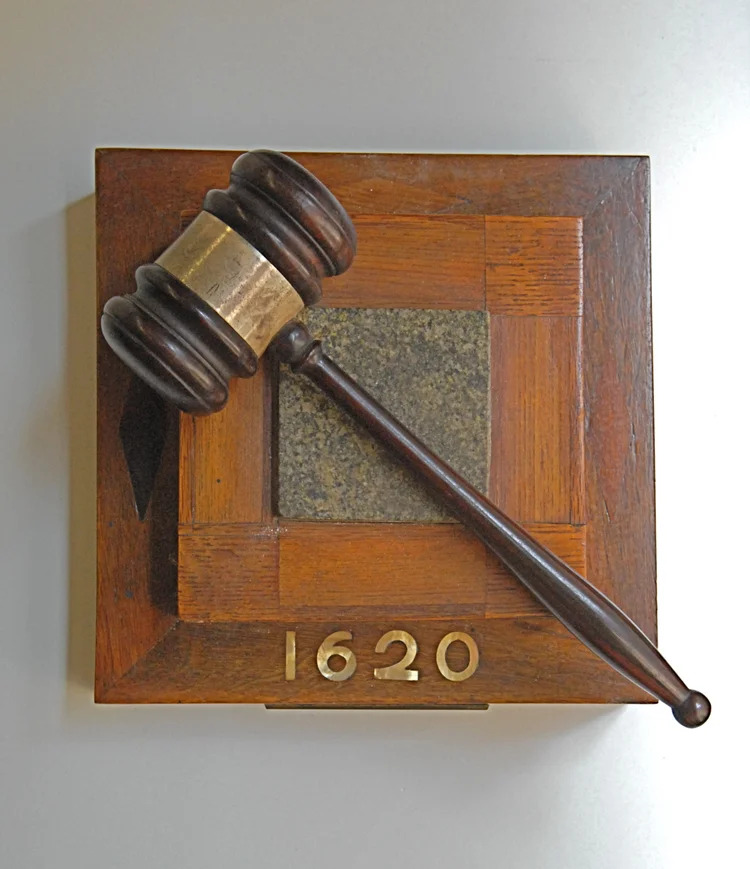
The block for the President’s Gavel features a small piece of Plymouth Rock that was broken off in 1859 when the foundation was laid for the canopy constructed over the rock.